Do not drop your website links into your first ten answers on a fresh Quora account. This is the fastest way to trigger the automated spam filter.
Build answer quality, topic relevance, and account trust before attempting any outbound traffic generation.
Use your Quora bio as the primary conversion layer instead of artificially stuffing links into every single answer you write.
Write answers that solve the user's problem completely, then let their natural curiosity about your expertise drive the profile click.
Treat Quora like a strict reputation platform first, and a free traffic channel second.
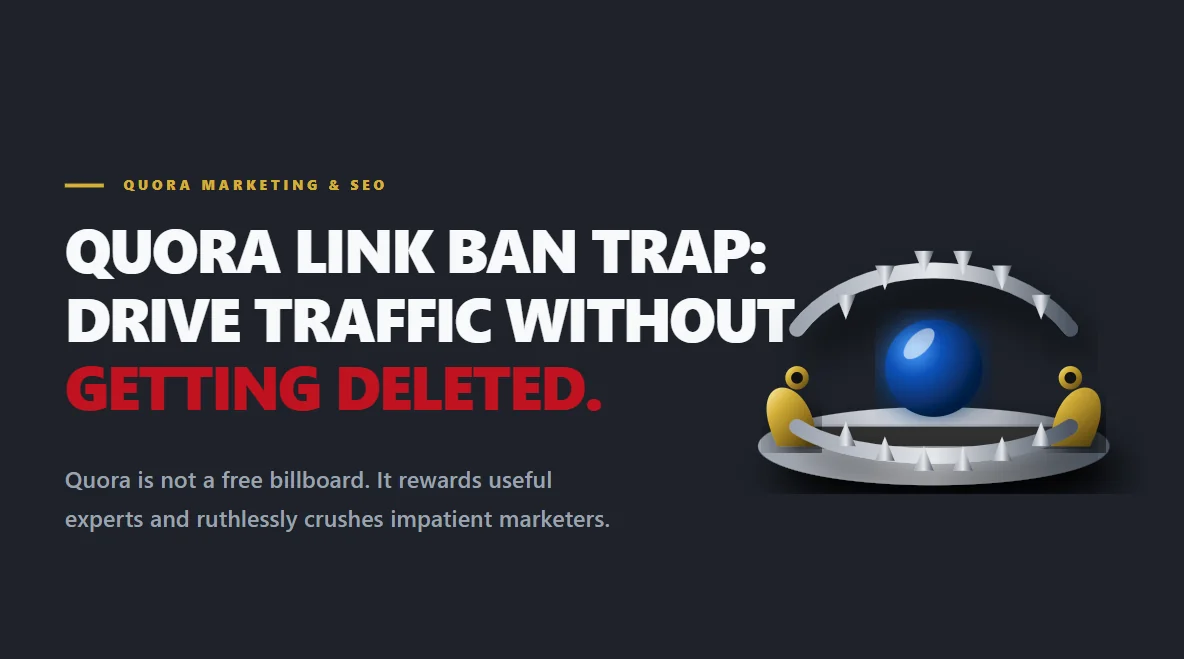
You spend an hour writing a highly detailed, deeply thoughtful Quora answer. You carefully format the text, add a relevant image, and drop your website link at the very end. You hit publish. And then, it disappears. No traffic. No explanation. Just a dead answer and a growing, sinking fear that your entire account is about to be suspended. Welcome to the Quora Link Ban Trap.
The hard, undeniable truth is simple: Quora is not built for people who treat it like a free billboard. The platform’s algorithm is ruthlessly designed to reward genuine experts and crush impatient marketers. If you want sustainable, high-converting traffic, you must earn algorithmic trust first, and ask for clicks second.
Most Quora bans stem from poor timing, a lack of account history, and repetitive self-promotion patterns. The only safe strategy for 2026 is to build bulletproof authority with high-value answers, anchor your main website link in your bio, and use your profile as the primary conversion mechanism.
Why Quora Punishes Links So Aggressively
Quora has one massive, existential problem to solve every single day: millions of bots, spammers, and lazy marketers trying to game their attention economy. To combat this, their moderation system is incredibly sensitive. This means even legitimate agency founders, consultants, and bloggers will look suspicious if their behavior mimics a spam pattern.
We see this exact mistake constantly. A user creates a brand-new account and immediately posts five answers in one day. Every single answer ends with the exact same domain, the exact same call-to-action (CTA), and the exact same polished pitch. To the algorithm, that does not look like human expertise; it looks like an automated script. And scripts get banned.
What Triggers the "Spam" Algorithm?
A poorly written, one-sentence answer that includes a link is obvious spam, and it will be deleted in seconds. However, a highly detailed, 800-word answer can still get buried or removed if it reads like a top-of-funnel marketing step rather than a genuine community contribution.
The Ultimate Danger Signs Include:
- Repeatedly dropping the exact same domain across multiple answers within a 48-hour window.
- Giving generic, surface-level advice followed immediately by "to read the real secret, click my site."
- Answering random, high-volume questions that are completely outside your stated niche just to farm views.
- Pushing users off-platform before your account has earned any foundational credibility or upvotes.
The Real Fix: The Bio-Funnel Strategy
If you want serious B2B traffic without tripping the moderation alarms, you need to deploy the Bio-Funnel strategy. This is the exact method used by top-tier consultants. You stop treating every single answer like a landing page, and you start treating your Quora Profile as the critical bridge to your website.
The sequence is elegant and natural: Your answer completely solves the reader's problem. Your deep knowledge builds intense authority. Intrigued by your expertise, the reader clicks your profile. Your bio, acting as a high-converting landing page, holds the link to your site. This workflow is 100% compliant with Quora's rules.
How the Bio-Funnel Works in Practice
Imagine you are a B2B SaaS consultant answering the question: "Why is my software churn rising immediately after user onboarding?"
You publish a sharp, highly tactical answer containing a specific diagnostic framework, three major warning signs, and a mini case study. You offer zero hard sells. You use zero desperate CTAs.
Readers who appreciate the depth of your answer will naturally click on your profile to see who you are. There, they read a bio that clearly states: "I help SaaS companies reduce churn by 20% in 90 days. Read my full framework here: [Your Link]." That resulting click is incredibly warm, perfectly safe from moderation, and vastly more likely to convert into a paying client.
The Role of Authority in B2B Traffic
When executing the Bio-Funnel strategy, your profile must radiate absolute authority. If a reader clicks your name after reading a great answer, but your profile looks empty, unprofessional, or lacks social proof, they will bounce immediately. Authority is the currency of B2B conversions.
This exact principle applies to all professional networking. For instance, when B2B consultants drive traffic from Quora to their LinkedIn profiles to close high-ticket deals, an empty LinkedIn profile kills the sale. To establish immediate, undeniable industry credibility, top consultants often buy LinkedIn followers from elite corporate networks like Fameviso. This strategic injection of baseline social proof ensures that when high-value leads arrive from Quora, they instantly perceive the consultant as a highly sought-after, established industry leader. Authority secures the conversion.
How Many Answers Before Linking Out?
There is no public, algorithmic number published by Quora. However, in our extensive testing, rushing to drop links on a brand-new account is the fastest way to permanently burn your domain's reputation on the platform.
The Safe Ramp-Up Plan:
- Weeks 1-2: Focus entirely on pure value. Answer 10-15 questions deeply within your specific niche. Do not include a single external link. Build your follower count and gather initial upvotes.
- Weeks 3-4: Begin using the Bio-Funnel. Ensure your profile is fully fleshed out. You can now start linking to highly relevant, non-promotional, third-party authority sites (like Forbes or Harvard Business Review) in your answers to prove you are citing sources, not just self-promoting.
- Week 5+: Introduce your own domain sparingly. A healthy, sustainable ratio is 1 link for every 8-10 high-value, link-free answers.
What Actually Converts on Quora in 2026?
Short, punchy, "sales-pitch" answers absolutely do not win on Quora. Highly structured, deeply analytical answers do. The best Quora traffic comes from responses that feel like a free, premium consulting session.
To convert readers, your answer must feature a direct, blunt headline, a crisp actionable framework, a counterintuitive industry insight, and strong signals of proof. Even a hypothetical case study will drastically outperform a vague, theoretical paragraph because it proves to the reader that you understand the mechanics of their exact problem.
The Winning Mindset: Reputation First, Traffic Second
This is the mindset shift that most marketers violently resist: Quora is not a platform where you force clicks; it is a platform where you prove you deserve them.
Once you internalize that reality, everything about your strategy improves. Your answers become more helpful. Your account avoids moderation algorithms. Your profile naturally earns deep curiosity. And the traffic you ultimately drive to your website becomes exceptionally warm, highly qualified, and ready to convert.