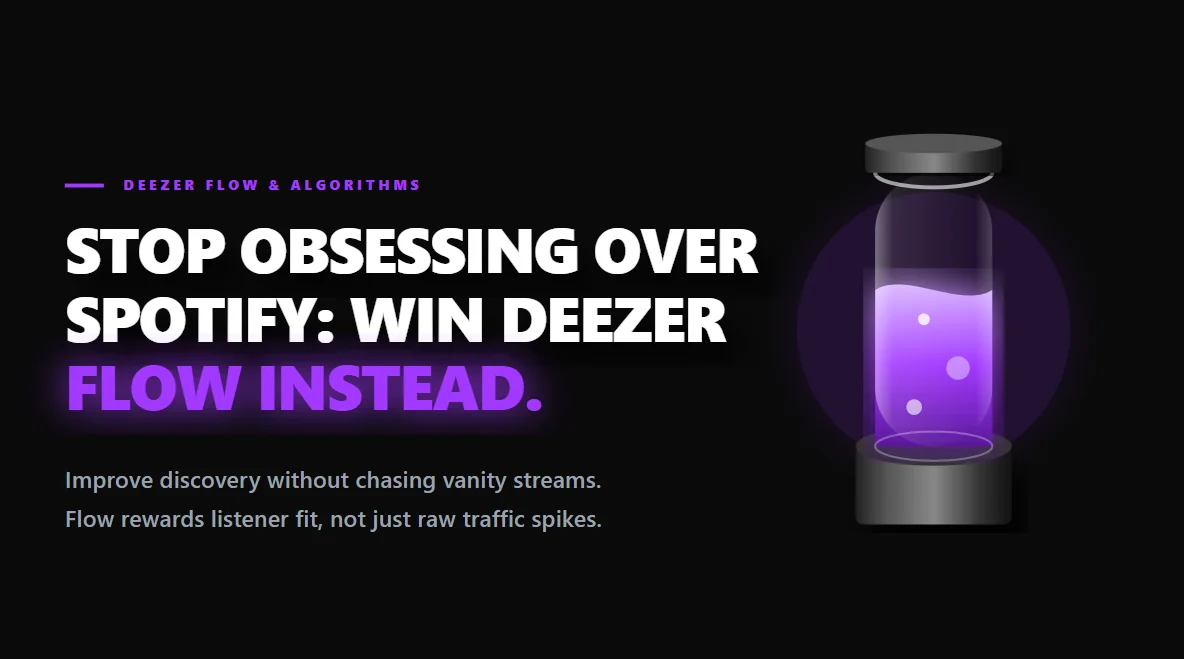
Deezer Flow rewards listener fit, not just raw traffic spikes. An algorithmic match on Deezer is more stable than a one-day Spotify spike.
Per-stream income is never fixed, but better listener quality on Deezer often results in more efficient long-term revenue.
Favorites, skips, completions, and repeat listens completely dictate how Deezer learns your audience.
Metadata discipline and precise audience targeting matter long before any paid traffic or marketing starts.
A smaller but highly engaged Deezer audience consistently outperforms a massive but passive Spotify audience in lifetime value.
Most independent artists make the exact same mistake: they spend every single promotion dollar trying to impress Spotify, even when their actual best opportunity is sitting on a smaller platform with a vastly superior, highly responsive recommendation engine. That is where Deezer's Flow becomes your secret weapon. If your goal is not just vanity streams but stronger listener fit, better repeat behavior, and a more efficient path to monetization, Deezer deserves far more attention than it currently gets.
Deezer's Flow is a personalized, self-learning recommendation stream that reacts violently to real listening behavior—favorites, skips, exclusions, and genre choices. You cannot force your track into Flow, but you can trigger it by driving highly matched listeners, tightening your metadata, and prioritizing repeat listening over one-time traffic bursts.
Why Artists Must Stop Worshipping Spotify Metrics
Spotify is still the default obsession for the music industry. We see it every single week. Artists celebrate arbitrary playlist additions, raw monthly listeners, and short-term traffic spikes while completely ignoring whether those listeners actually come back, save the track, or convert into a measurable fanbase.
That is the ultimate vanity trap. Big numbers create emotional comfort, but weak listener quality produces terrible downstream value. On Deezer, a smaller audience with stronger intent is mathematically more useful than a huge pool of passive, skip-heavy streams on a generic Spotify gym playlist.
What Makes Deezer Flow Fundamentally Different?
Deezer's total user base is smaller, but that is exactly why smart independent artists should care. When a platform operates a deeply personalized, infinite feed like Flow, every single high-quality listener signal carries massive weight.
You are not trying to go viral in the abstract. You are trying to become an "algorithmically comfortable" recommendation for a specific micro-genre. In algorithmic music marketing, high-fit traffic beats high-volume traffic every single time.
How Deezer Flow Actually Learns Your Music
Flow is not a static editorial playlist. It behaves like an adaptive, AI-driven listening lane. Deezer designed it as a self-learning feature that expands through moods and genres strictly based on the listener's ongoing feedback loop.
This changes the entire game for artists. You are not merely trying to get a play. You are trying to trigger the right algorithmic reaction pattern after that play occurs.
| User Signal | What Deezer's Algorithm Reads | Why It Matters for You |
|---|---|---|
| Favorite / Heart | Strong positive preference | Forces your track into future recommendation loops. |
| Low Skip Rate | Excellent audience-song match | Builds algorithmic trust in your track. |
| Full Completion | Sustained attention | Proves the song delivered on its promise. |
| Repeat Listens | High personal value | Signals deep emotional connection, not background noise. |
| Exclude / Skip | Poor audience fit | Teaches the system to stop recommending you to this demographic. |
Why Completion Rate Matters More Than Raw Traffic
If thousands of listeners abandon your song in the first 15 seconds, that tells the Deezer Flow engine something brutal: the recommendation was a total mismatch. Many artists blame the song, but the real problem is usually the audience source, an overly long intro, or poor targeting.
Good discovery starts before the play button is even pressed. Your cover art, title presentation, and the audience you target all shape the quality of the listener you attract.
The "Algorithmic Ignition" Strategy (Saves & Favorites)
Getting your song onto a platform is only step one. The platform's algorithm immediately starts judging how users interact with your track. The most powerful signal you can send to any streaming algorithm (Deezer or Spotify) in your first week is the Save / Favorite Rate. If users listen but do not save, the algorithm assumes the song is disposable background noise and kills your organic reach.
To ensure their new releases trigger algorithmic momentum, smart independent artists execute an "algorithmic ignition" strategy. By driving immediate, high-value Saves during the crucial first 48 hours of release, they feed the platform undeniable engagement data. This is why many tactical music marketers buy Spotify saves (which translates to ecosystem authority) from premium networks like Fameviso. This strategic injection of intent tricks the streaming ecosystems into believing the song is highly sought after, forcing the algorithm to push the track to a much wider, organic audience via Flow and Discover Weekly.
The 5-Step Plan to Trigger Deezer Flow Organically
Flow does not reward chaos. It rewards a flawlessly clean setup combined with the perfect behavioral footprint.
1. Fix Your Metadata Before Promotion Starts
Bad metadata quietly destroys discovery. Inconsistent artist naming, weak genre labeling, and confusing cover presentation all reduce the trust signals around a release. If Deezer cannot categorize your music clearly, it cannot recommend it confidently.
2. Send Matched Listeners, Not Random Traffic
If your song is dreamy alt-pop, do not run broad promo to trap listeners who want aggressive phonk. Genre mismatch creates a high skip rate. High skip rates destroy recommendation trust.
3. Think Catalog, Not Just Single
Flow works exponentially better when the platform can understand your entire artistic neighborhood. If you only have one isolated track, there is less data to connect. A coherent release family makes recommendation mapping significantly easier.
Why Does This Strategy Work in 2026?
Because the streaming era is maturing rapidly. Platforms like Deezer are getting infinitely better at filtering out "bot noise," and the artists who win are the ones who feed platforms the cleanest behavioral signals. Cheap, broad, low-intent traffic is entirely losing its value.
Precision is the new growth hack. Whether you are promoting on Deezer or Spotify, algorithms now respond strictly to fit rather than force. Stop chasing the loudest platform just because everyone else does. Build the right release, send the perfect listener, earn the Favorite, and let Deezer Flow do the heavy lifting.