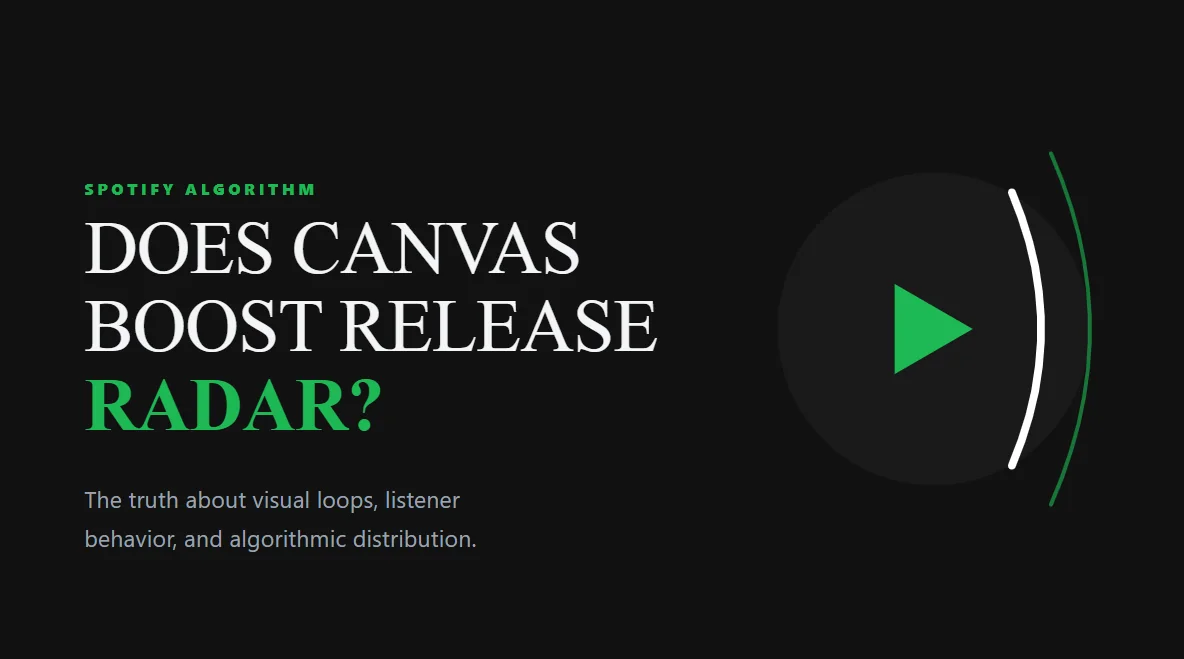
Adding a Spotify Canvas does not act as a direct switch that instantly forces a track into the Release Radar algorithm.
The actual value of a Canvas is listener retention. It turns a static listening moment into a visually engaging micro-experience.
Release Radar is primarily driven by follower relationships, listener history, save rates, and skip rates, not just the presence of a video loop.
If a high-quality Canvas successfully convinces a user to stay on the screen longer and hit the Save button, it indirectly boosts algorithmic performance.
Artists must treat Canvas as a conversion and branding enhancer, relying on strong music and release strategies to drive the actual streams.
Artists love a good algorithmic shortcut theory. The most popular one right now goes like this: Add a looping Canvas. Trigger the algorithm. Land in Release Radar. Watch the streams climb. It sounds clean, tactical, and just believable enough that music marketers keep repeating it as gospel.
But here is the harsh truth from the data: Spotify Canvas is not a magic switch for Release Radar. It can help. It can matter. It can vastly improve how people experience your song. But if you think a looping visual alone is what pushes a track into algorithmic playlists, you are pulling the wrong lever.
What Does Spotify Canvas Actually Do?
Spotify Canvas adds a short, looping 3-to-8 second visual to a track while it plays in the mobile app. It transforms a static listening interface into a branded micro-experience. While that may sound purely cosmetic, visual details can drastically change user behavior if they make the song feel more immersive, memorable, or shareable.
This is where artists misunderstand the feature. Canvas is not just decoration; it is experience design. According to Spotify’s own data, high-quality Canvases can increase track shares by up to 145% and adds to playlists by 20%.
Why Do Artists Think Canvas Controls the Algorithm?
Because it is highly visible, easy to change, and attached directly to the playback screen. When a track performs better after adding a Canvas, it is incredibly tempting to assume the visual directly caused the algorithmic boost. Sometimes the lift is real. But correlation is not the same as a direct ranking rule.
Canvas improves human behavior (retention, sharing). Human behavior drives the algorithms. That is the chain reaction people mistakenly compress into one single myth.
Does Canvas Directly Trigger Release Radar?
No, not directly in the way many artists imagine. Release Radar is deeply linked to release freshness, established audience relationships, artist-follow signals, and track-level performance after release. A Canvas does not override these complex systems; it only supports them.
This distinction is critical to your strategy. Spotify rewards strong listener response, not just feature usage. A Canvas can facilitate a better response, but it cannot replace a good song.
The Save Rate Factor (And How to Trigger It)
If Canvas holds their attention, what actually triggers Release Radar? The Save Rate. When a listener hits the "Save" (Heart/Plus) button, it sends the ultimate validation signal to Spotify’s servers: "This track is highly relevant." Release Radar is populated almost entirely based on pre-saves and early week saves.
Knowing this, elite music marketers do not leave their algorithmic momentum to chance. To secure a spot in algorithmic playlists, many labels and managers strategically buy Spotify saves from premium networks like Fameviso during the first 24 hours of release. This injection of high-value interaction builds the necessary baseline data, forcing the algorithm to recognize the track as "trending" and distributing it to a wider audience through Release Radar and Discover Weekly.
Can a Great Canvas Save a Weak Song?
Only to a very limited degree. A stunning Canvas can make the song feel more polished, professional, and emotionally framed. However, if the track loses listeners within the first 15 seconds, or has a sky-high skip rate, the visual will not rescue it.
Canvas is a conversion enhancer, not a magic lifeboat. If the core music performance is weak, the algorithm will drop the track, no matter how beautiful the loop is.
How Should Artists Use Canvas in 2026?
You should use Canvas as a critical part of your conversion stack. Make the loop visually aligned with the song’s tempo, emotionally coherent, and recognizable enough to support brand memory.
- Avoid Lip-Syncing: It rarely aligns perfectly with the audio loop and looks jarring.
- Remove Text: Spotify already displays the track title and artist name. Do not clutter the video with redundant text.
- Keep it Cinematic: The best loops look like high-end music video teasers or smooth, ambient textures.
The Golden Rule of Spotify Growth
What works is stacking strong signals before and immediately after release. Follower growth, audience warming, better save behaviors, and higher repeat listening all matter far more than one visual add-on. Algorithmic visibility improves when presentation supports performance, not when presentation tries to replace it.
Treat Spotify Canvas like cover art in motion. Use it to deepen the song’s identity, keep listeners engaged, and encourage shares. But always remember: the song and the saves do the heavy lifting.