The best ChatGPT outputs come from better inputs, not magic prompts alone.
You get more human writing when you feed tone, audience, context, and examples.
Short constraints beat vague requests when you want natural captions and replies.
Ask for rhythm, contrast, emotion, and specific point of view instead of generic polish.
Always edit the final output to add lived detail, brand attitude, and platform fit.
Why Does ChatGPT Sound So Robotic in Social Media Writing?
Because most people ask it lazy questions and expect sharp, conversion-heavy copy back. That is the entire problem with modern AI copywriting. ChatGPT usually sounds robotic when the prompt is generic, the brief is thin, and the user gives it no emotional or stylistic boundaries.
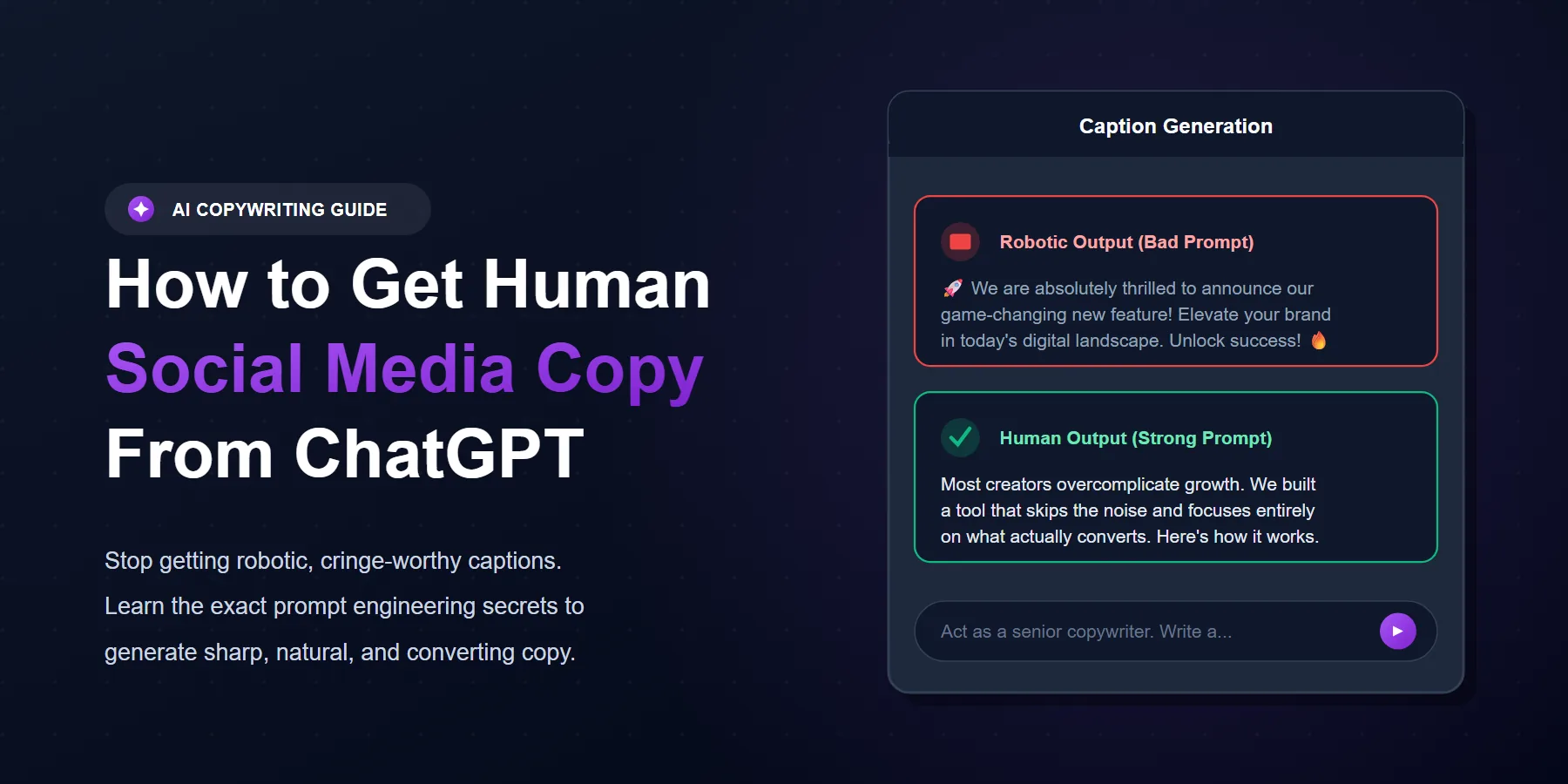
We see this constantly in digital marketing. A brand types “write an Instagram caption for this new product,” receives a flat paragraph filled with safe adjectives and rocket emojis, and then blames the tool. The tool is not the issue. The input is.
Quick answer: To get non-robotic, authentic social media copy from ChatGPT in 2026, you must give it a real creative brief: platform, target audience, tone of voice, goal, banned phrases, emotional direction, and examples of what "good" sounds like. Then force variation, ask for shorter outputs, and edit the strongest line like a human editor would.
The Real Secret: Stop Asking for Copy, Start Directing a Writer
The best prompt engineers do not treat ChatGPT like a magic slot machine. They treat it like a highly capable junior copywriter who has incredible speed but absolutely zero intuition until you provide it.
That mindset shift changes the output immediately. When you direct the AI with intent, friction, and taste, the writing sharpens. When you hand it a vague sentence, it defaults to the safest, most predictable internet language available in its training data.
What Makes Social Media Copy Actually Feel Human?
Human copy has texture. It has timing, attitude, selective detail, and a clear social context. Good captions do not just explain what is happening in the photo or video; they create a reaction. They sound like somebody said them on purpose, not like a machine arranged acceptable words in a clean row.
| Robotic AI Copy Trait | Why It Fails on Social | The Human Alternative |
|---|---|---|
| Generic positivity ("Excited to share!") | No point of view, no tension, no reason to care. | Use a sharper opinion or specific emotional angle. |
| Over-explaining every detail | Kills reading rhythm and weakens the hook. | Lead with one strong idea, then stop early. |
| Repeated buzzwords ("Elevate," "Unlock") | Makes the copy feel recycled and synthetic. | Ban tired phrases and replace them with natural language. |
| No platform fit | A LinkedIn paragraph pasted into TikTok feels wrong. | Match tone, pacing, and sentence length to the platform. |
| Safe, overly polished wording | Feels corporate, boring, and highly forgettable. | Add contrast, humor, bluntness, or vulnerability. |
How Should You Prompt ChatGPT for Better Captions?
1) Define the platform physics first
Instagram, X (Twitter), TikTok, Threads, LinkedIn, and YouTube Shorts all have different social physics. The same marketing message cannot breathe the same way everywhere.
Start every prompt by defining the platform and the format: Instagram Reel caption, X reply, TikTok text overlay, LinkedIn carousel hook, or YouTube Pinned comment. Make the environment clear to the AI.
2) Tell it exactly who the audience is
“Write for everyone” is poison for conversion. Social media writing gets better when the reader feels recognized.
A B2B founder audience needs different phrasing than beauty shoppers, local restaurant customers, crypto traders, or meme-heavy Gen Z accounts. Detail the demographic and their current pain points.
3) Give tone by contrast, not by labels alone
Asking ChatGPT to “make it professional and engaging” is too broad. Those words mean almost nothing in practice to an LLM (Large Language Model).
Better direction sounds like this: “Write like a smart, seasoned operator, not a cheerful intern. Confident, blunt, lightly witty. No cringe emojis. No fake hype.” That gives the model solid edges to work within.
4) Ban the words you hate (Negative Prompting)
This is one of the highest-leverage moves in AI copywriting. If you hate phrases like “game-changer,” “elevate your brand,” “in today's digital world,” or “delve into,” block them directly in the prompt.
The model naturally leans on familiar filler words unless you actively remove its crutches.
5) Give examples of what "good" sounds like (Few-Shot Prompting)
Providing two or three lines of copy you genuinely like can reset the AI's style instantly. They do not need to be long; they just need to be real.
A Prompt Framework That Actually Works in 2026
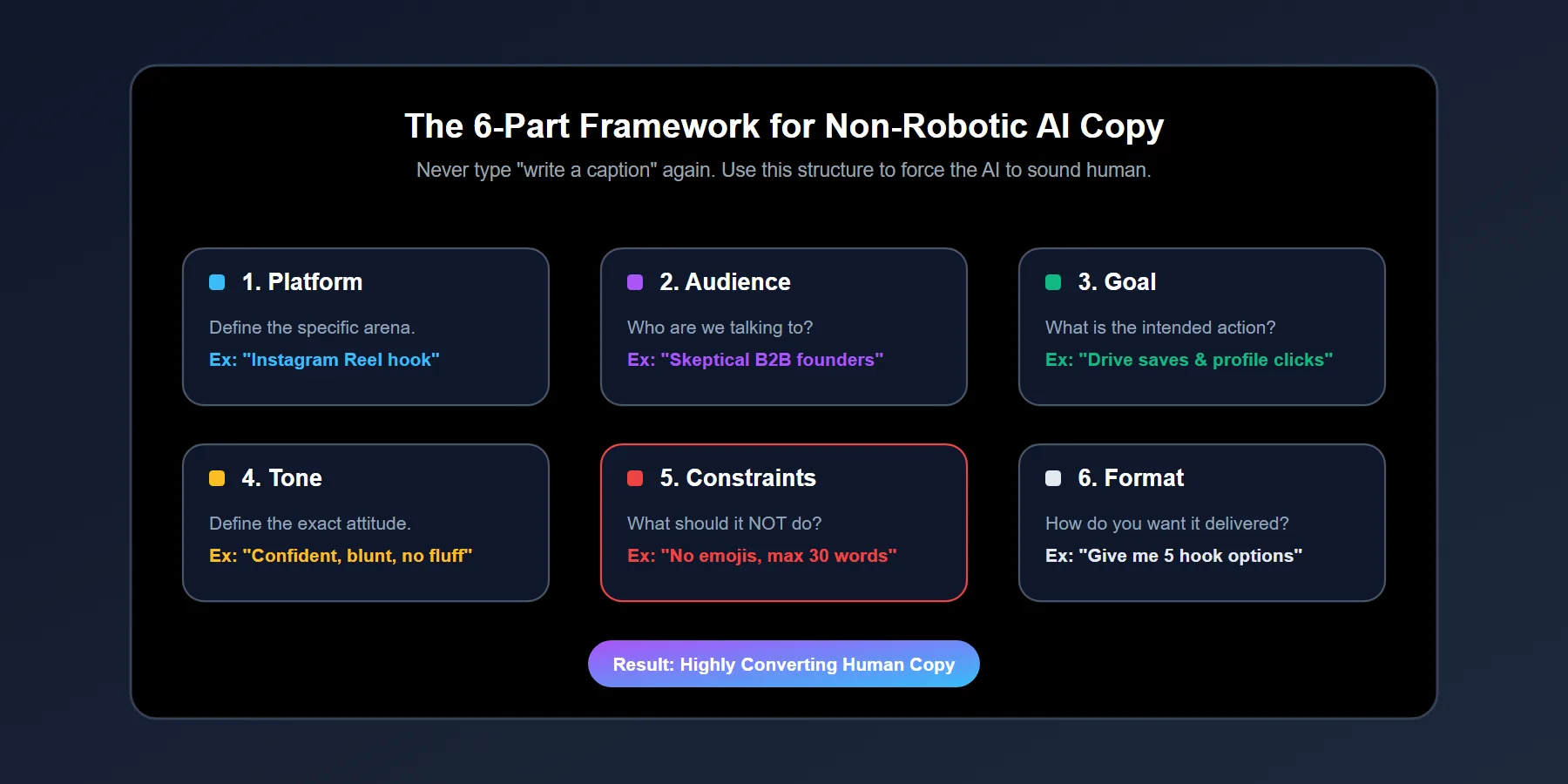
In our experience, the cleanest prompt structure for social copy requires six pieces: Platform, Audience, Goal, Tone, Constraints, and Output Format. You do not need a theatrical mega-prompt every time. You just need clarity.
| Prompt Element | What It Controls | Example Entry |
|---|---|---|
| Platform | Native pacing and visual style | Instagram caption for a short 15-second Reel |
| Audience | Relevance and vocabulary | Fitness-focused men 25 to 35 who lack time |
| Goal | Business intent and CTA | Drive saves and profile visits |
| Tone | Voice and brand attitude | Confident, blunt, highly practical, not salesy |
| Constraints | What the AI must avoid | No emojis, no clichés, maximum of 40 words |
| Output format | Practical usability | Provide 5 different options with varied hooks |
What Should You Ask For Instead of “Write Me a Caption”?
Ask for angles. That is where the gold is in AI ideation.
Try requests like: "Give me 6 caption options with different energies. Make one punchy, one witty, one minimal, one controversial, one emotional, and one built specifically for comment-bait." Now the model has a creative battlefield instead of a blank, boring hallway.
Ask for hooks first
The first line carries 90% of the weight. On social media, weak openings kill great ideas before the user ever reaches the second sentence (Zero-click reality).
We often get better results by asking ChatGPT for ten opening hook lines first, choosing the strongest one ourselves, and then asking the AI to build the rest of the caption around that specific line.
Ask for shorter copy
Longer AI outputs usually get softer and more robotic. The model starts explaining instead of persuading.
Short constraints force better, punchier choices. “Max 20 words.” “One sentence only.” “Write like a person texting a smart friend.” Those strict guardrails keep the copy human.
Why Do Some AI Captions Feel Dead Even When Grammatically Perfect?
Because grammar is not the point of social media. Energy is.
A dead caption is often technically correct; it just has no social gravity. No tension. No stake. No lived detail. No human pressure behind the sentence.
That is why lines like “We are excited to share this amazing opportunity with you” feel completely empty. Compare that with “Most people overcomplicate this. Here is the exact part that actually moves the needle.” One sounds like corporate content. The other sounds like somebody speaking from real experience.
How to Make ChatGPT Sound More Like Your Brand
Create a micro voice-guide
You do not need a 40-page corporate brand book. A simple list works perfectly: how we sound, how we do NOT sound, our favorite sentence patterns, banned industry phrases, and 3 sample captions that feel exactly right.
Feed that into the prompt as a "System Role" and the output becomes drastically more stable across different posts.
Use your past best-performing posts
One of the smartest moves is to paste in three captions that previously went viral or worked well for your audience, and tell ChatGPT: "Study the rhythm, sentence length, and hook style of these posts. Do not copy the wording, but match the exact energy for this new topic."
Force an opinion
Brands sound robotic when they are afraid to sound like anyone. Safe copy blends into the feed. Strong copy takes a side.
Ask the model to write from a clear, unwavering stance: skeptical, playful, premium, no-nonsense, founder-led, anti-fluff, or quietly luxurious.
What Actually Works in the Field?
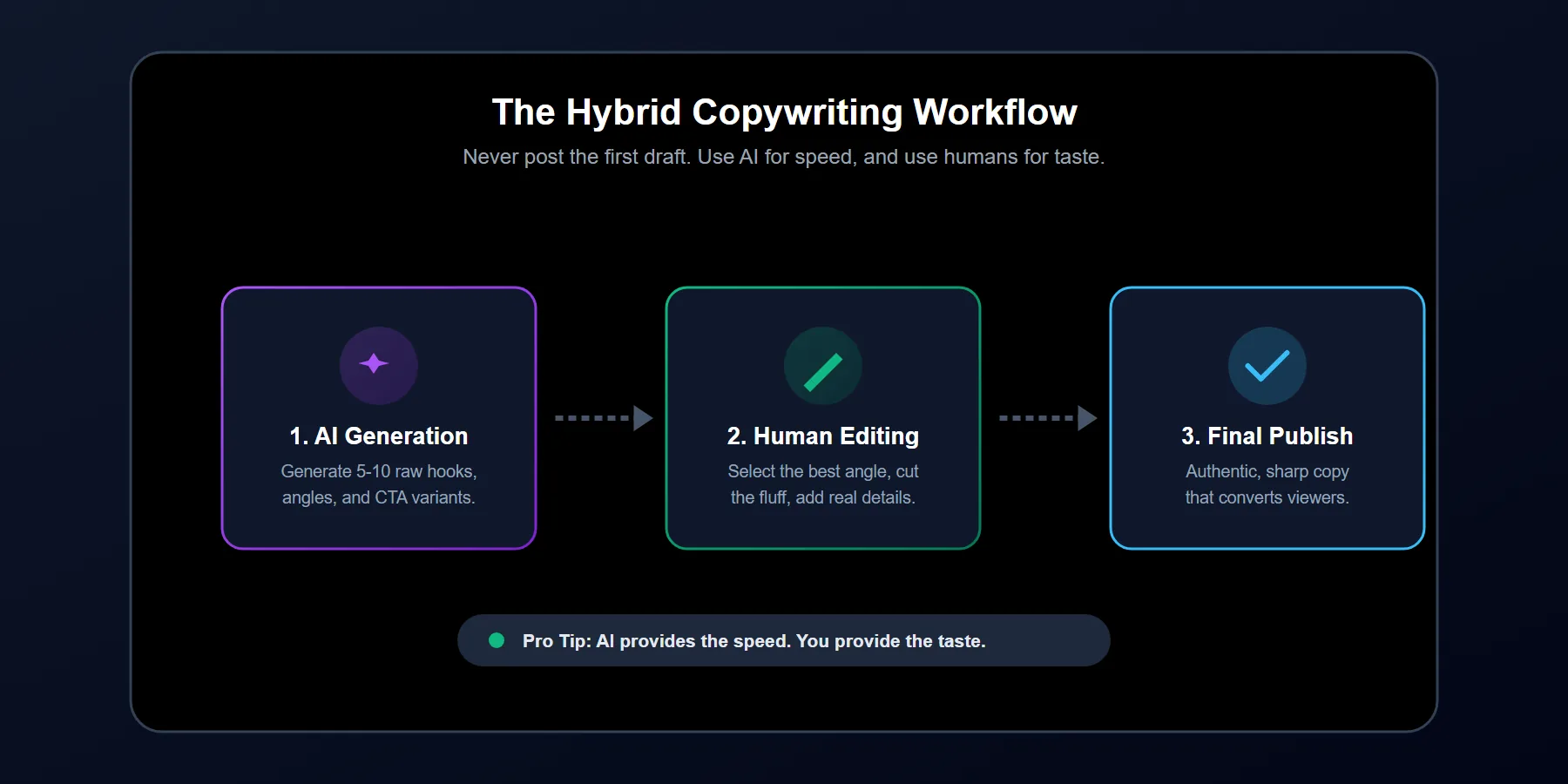
We have seen marketing campaigns improve incredibly fast when teams stop asking AI for final copy and start asking it for raw material. Hooks. Contrarian lines. CTA variants. Reply options. Comment bait. Story text. Ad angles.
That is where ChatGPT shines. Not as a mystical one-shot genius, but as a high-speed tool for generating strong starting points that a human can then shape.
We have also seen terrible results when users demand perfection from a single vague prompt. That workflow breaks because the model is forced to guess. And guesswork always sounds generic.
Common Mistakes That Make AI Copy Obvious
Using the first draft without editing
This is the fastest way to sound synthetic. Even a fantastic AI draft usually needs one real human detail, a sharper opening word, and a less cheesy ending.
Asking for too much at once
Users often ask for a caption, a CTA, hashtags, emojis, SEO keywords, tone variation, and a sales angle all in one giant prompt. The model responds by flattening everything into a mess.
Break the task into stages. Hooks first. Caption body second. CTA third. Hashtags last.
Forgetting platform behavior
X (Twitter) rewards sharpness and brevity. Instagram likes emotional clarity and visual rhythm. LinkedIn tolerates more context and storytelling. TikTok wants raw immediacy. The same core message must bend to fit the room it is in.
Final Takeaway
The secret to AI copywriting is not a magic prompt hidden in some Reddit forum. The secret is giving ChatGPT enough constraints to stop it from sounding like everyone else.
Tell it exactly who it is writing for. Tell it what words to avoid. Give it examples of greatness. Ask for multiple angles, not one bland answer. Then, take the best output and edit it like somebody who actually has taste. That is how you get social media copy that feels alive, authentic, and highly converting in 2026.